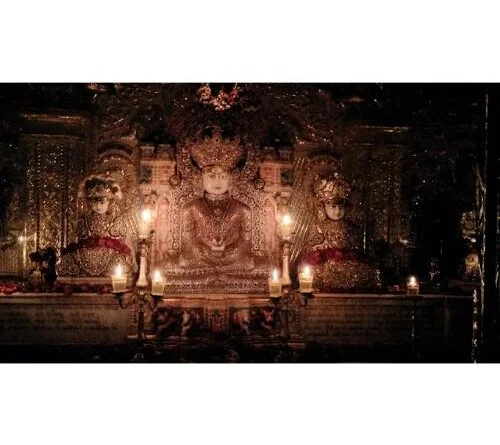
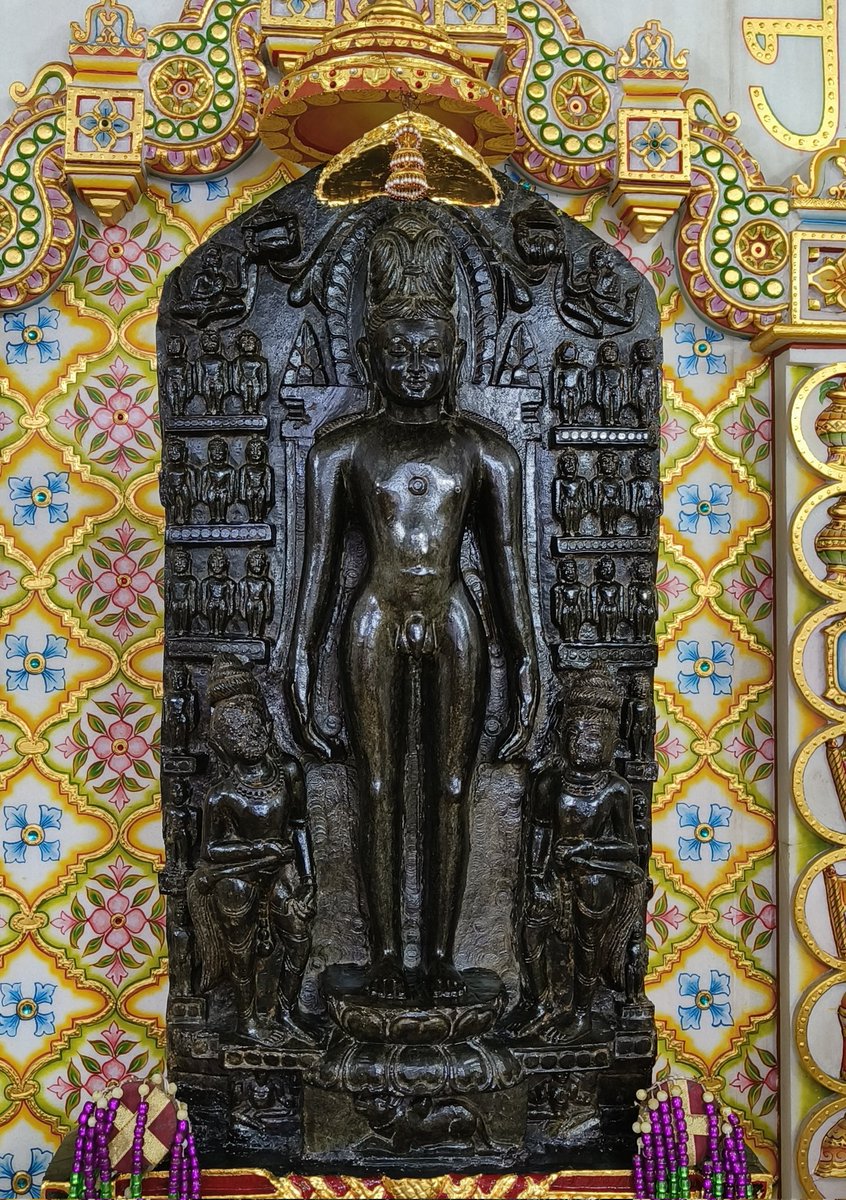
The sacred iconography, symbols and cosmic context that frame Mallinath Bhagwan’s timeless place in the Jain tradition.
Each Tirthankara is associated with a sacred symbol — a lakshana — which devotees use to identify and venerate the awakened one. Mallinath Bhagwan is traditionally associated with the kalasha, the sacred water-pot, an emblem of fullness, purity and the contained ocean of inner being.
Jain cosmology describes a continuous wheel of time in which twenty-four Tirthankaras arise in each descending half-cycle to re-establish the eternal dharma. Mallinath Bhagwan stands as the nineteenth in this current Avasarpini — between the radiant lineage of those who came before and the great Tirthankaras who would follow.
His position is not merely chronological. Each Tirthankara responds to the spiritual condition of their era — and the message borne forward through Mallinath is the one most needed by a humanity gathered around the seductions of form: see beyond, and be free.

Both venerable streams of Jain tradition hold Mallinath in supreme reverence — preserving complementary perspectives that together honour the soul’s transcendence of every category.
The Svetambara tradition holds that Mallinath was a woman who attained perfect omniscience — Malli Kumari, princess of Mithila, who transcended every worldly bond. This unique reverence stands as a profound theological statement: the path of the awakened soul is not bound by the body’s form. She is the only female Tirthankara recognised in this stream — a luminary who illumines the equality of all souls in their capacity for liberation.
The Digambara tradition reveres Mallinath as a male ascetic of sky-clad simplicity, whose total renunciation of every external form embodied the highest discipline of the soul. In this stream, the path of the male digambara renunciate — stripped of every garment and possession — is held as the supreme conduct, and Mallinath’s example shines as one of its purest expressions.
Across both streams, devotees agree on what is essential: the soul that has known itself is liberated — the rest is reverent narrative honouring that one supreme truth.
A brief orientation to the spiritual landscape that frames every Tirthankara’s descent.
Jain cosmology envisions a vast, ordered universe of ascending and descending realms. The Tirthankaras appear in the human realm — Madhya-loka — to teach the eternal dharma.
Karma in Jain thought is not an abstract law but subtle matter that adheres to the soul, obscuring its native light. Liberation is the gradual dissolving of this karmic veil.
The soul is eternal, conscious, and intrinsically pure. Every being holds within it the same potential as a Tirthankara — to awaken to its own infinite nature.
The cosmic wheel turns through ascending and descending half-cycles. We presently dwell in an Avasarpini — a descending age in which Mallinath Bhagwan arose as the nineteenth Tirthankara.
After Kevala Jnana, each Tirthankara teaches from the Samavasarana — a celestial pavilion gathering devas, humans and animals in perfect harmony to receive the eternal sutras.
Beyond the wheel, beyond karma, beyond names — the soul abides in its own eternal radiance. This is the destination toward which every Tirthankara’s teaching points.

Across India, numerous temples are devoted to Mallinath Bhagwan — among them the venerable shrines of Mithila and the celebrated Mallinath temples of Kumbhalgarh, Ranakpur and other heritage sites. Each is a doorway through which devotees enter into communion with the Tirthankara’s timeless presence.
Sacred scriptures — Agamas, Stotras and Chalisas — preserve hymns of praise and reflective teachings that have been chanted across generations. Festivals, pilgrimages and silent prayer continue the unbroken thread of devotion.